

On 21 and 22 November, 2025 the University of Tokyo, in collaboration with the Chey Institute for Advanced Studies, held the annual Tokyo Forum, founded in 2019. Prominent scholars and business leaders from around the world gathered to discuss one of the most pressing issues of our time, focusing on how capitalism as an economic system can evolve to better serve our shared futures.
The symposium, titled ‘Rethinking Capitalism: Varieties, Contradictions, and Futures’ was held at the iconic UTokyo Yasuda Auditorium located on the Hongo Campus, using real-time Japanese-to-English translation to accommodate the predominantly Japanese audience. The opening remarks were provided by UTokyo President Teruo Fujii, alongside the Chairman of the SK Group, a multi-billion-dollar South Korean conglomerate, Tae-won Chey.
Challenges and solutions to capitalism
In the Plenary Talk, prominent scholars from Japan, South Korea and the U.S. discussed how capitalism can be contained, expanded, or rebuilt to better serve society.
Labour economist Marianne Bertrand, a professor at the University of Chicago, argued that the contemporary form of inequality-driven capitalism emerged from changes in the U.S. economy since the 1970s. Prof Bertrand clarified that this inequality was caused by the U.S. government’s lack of initiative towards addressing market failures. She called for initial reforms such as rebuilding trust in government, reducing money’s role in politics, and rethinking corporate structures. In doing so, capitalist profit maximisation can be contained to address the wealth gap between rich and poor.
UTokyo Graduate School of Economics professor Fuhito Kojima discussed market design—the science of designing economic institutions to achieve better and fairer outcomes. Prof Kojima added that market design makes use of both capitalism, which makes decisions based on individual information, and socialism, which incorporates deliberate institutional planning, to overcome the limitations of both. He argues that the use of market design should be increasingly implemented to address inefficiencies.
Seoul National University economist and professor, Byung-Yeon Kim, evaluated whether AI socialism—the idea that artificial intelligence can improve central planning—could replace capitalism. Some suggest that AI can eliminate problems of incentive, address inequality, and manage real-time production. Prof Kim clarifies that while the above may be true, AI socialism is not practical in the real world, as no single government’s central plan can control the decision-making of other countries. Rather, he drew on the ideas of influential economist Adam Smith, arguing that capitalism demands mutual sympathy over self-interest. Public conscience, or what Smith called the “impartial spectator”, is necessary for reform, as people must move past their selfish ambitions and embrace a more sustainable capitalist system.
The presentations by these world-renowned scholars laid the foundation for the forum’s subsequent exploration of capitalism’s relationship to democracy, academia, sustainability and space.
The indispensable role of corporations
In the Business Leaders session, prominent business leaders from Japan and South Korea firmly agreed that the prevailing economic system is under strain. The discussion made clear that widespread changes must be implemented to address rising inequality, technological change, and social fragmentation.
Senior Vice Chairperson of the Keizai Doyukai (Japan Association of Corporate Executives), Mutsuo Iwai, clarified that over three decades of wage stagnation, rising corporate dividends, inflation and low labour mobility have deepened social division in Japan. Iwai introduced Collaborative Capitalism, a concept proposed by the Keizai Doyukai in 2023. The idea is to promote cross-sector collaboration between government, businesses and civil society to solve social problems while simultaneously creating corporate value. Similarly, South Korean business leaders emphasized that social value must be embedded in economic incentives, especially amidst demographic decline. To address these challenges, Chairperson Chey uses a gamified “social progress credits” reward system in the SK Group. The company offers financial incentives to employees whenever they generate measurable social value from their work. Since its introduction in 2015, the SK group has paid 71.5 billion won ($48.5m; £36m) in cash incentives for upwards of 500 billion won ($339m; £253m) in social performance, indicating that social progress credits could be a successful model for other corporations to adapt in the future.
Youth engagement in Japan and South Korea
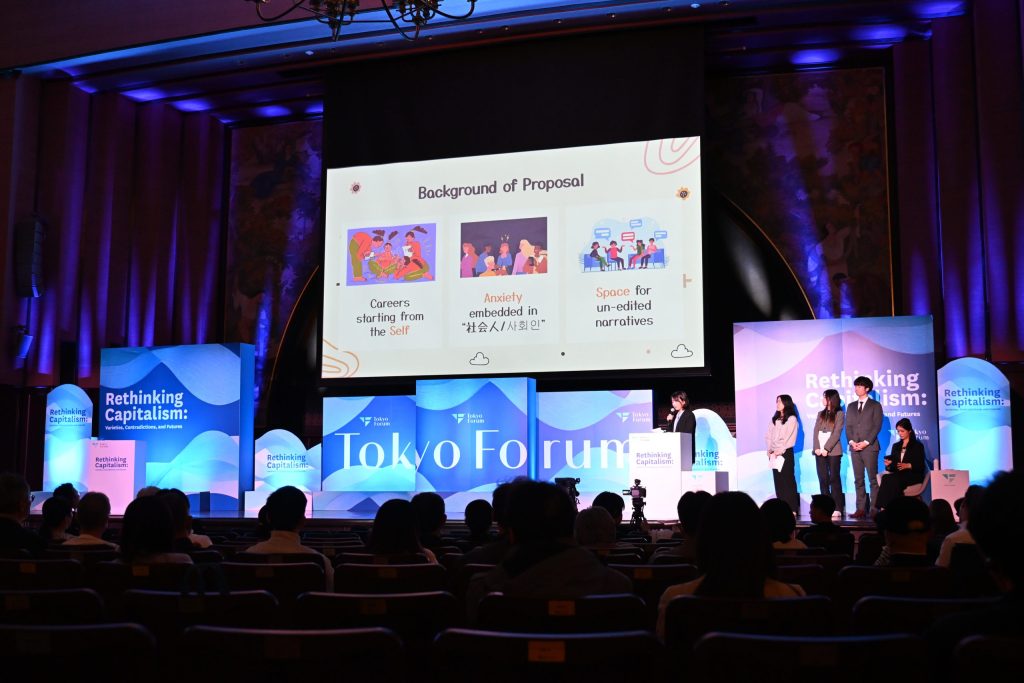
In the Youth Session, jointly delivered by students from the University of Tokyo and top South Korean universities such as Ewha Woman’s University and Yonsei University, participants presented findings from a collaborative course examining how younger generations experience and reshape capitalism. What initially began as an abstract economic concept, became deeply personal as students studied the way capitalism shapes social relationships, community life, career anxiety and consumption in their daily lives. Presentation topics ranged from the pressure to become a shakaijin (working adult) to understanding the rise of an “intimacy economy” in the age of AI—where traditional relationships could be replaced by a manufactured companion. Furthermore, other groups discussed how small-scale interventions such as a shared breakfast community, making ethical consumption trendy, and implementing fair trade schemes, could gradually facilitate empathy within capitalist societies.
Structurally, students questioned whether today’s capitalist system, fuelled by competition, can still allow the next generation to innovate and participate meaningfully in society. To address existing challenges, groups proposed redesigning university start-up incubators through collaboration with venture capital organizations. This could lower barriers to entrepreneurship and help redefine success beyond monetary measures.
While the groups presented diverse topics, one thing was emphasized repeatedly: capitalism’s challenges are intersectional and multifaceted—shaped by gender, economic inequality and global exploitation. To end the panel off on a hopeful note, Vice President and Director of the Center for Global Education at UTokyo, Yujin Yaguchi, clarified that although the student presenters benefit from and are “winners of capitalism,” they remain compelled to change it for the better.
Capitalism remains our collective responsibility
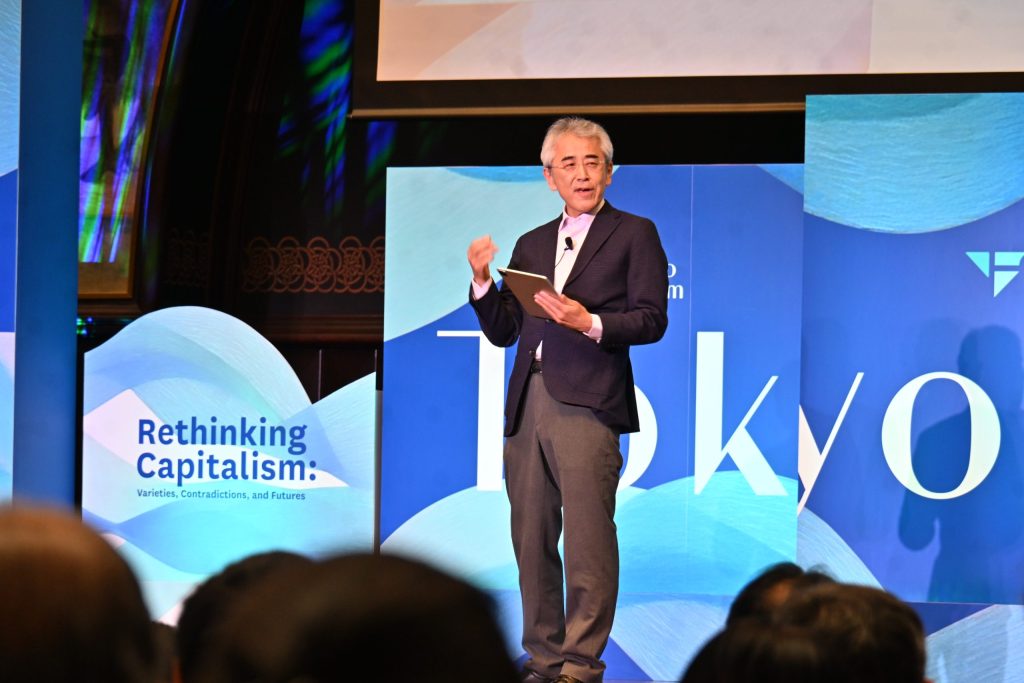
The Tokyo Forum demonstrated that capitalism is neither fixed nor finished but constantly changing. Through perspectives from leading scholars, business leaders as well as students from Japan and South Korea, the event offered a comprehensive understanding of the different varieties, contradictions and possible futures of capitalism. From stronger government intervention to youth innovation, a common theme across the diverse solutions that emerged was a consensus that “rethinking capitalism” is necessary—creating a system that works for all people and the planet is our collective responsibility.