
Studying abroad is an unusual halfway point: while exchange offers a unique opportunity to leave the routine of ordinary life and experience new things, the extended nature means that establishing a new rhythm is necessary.
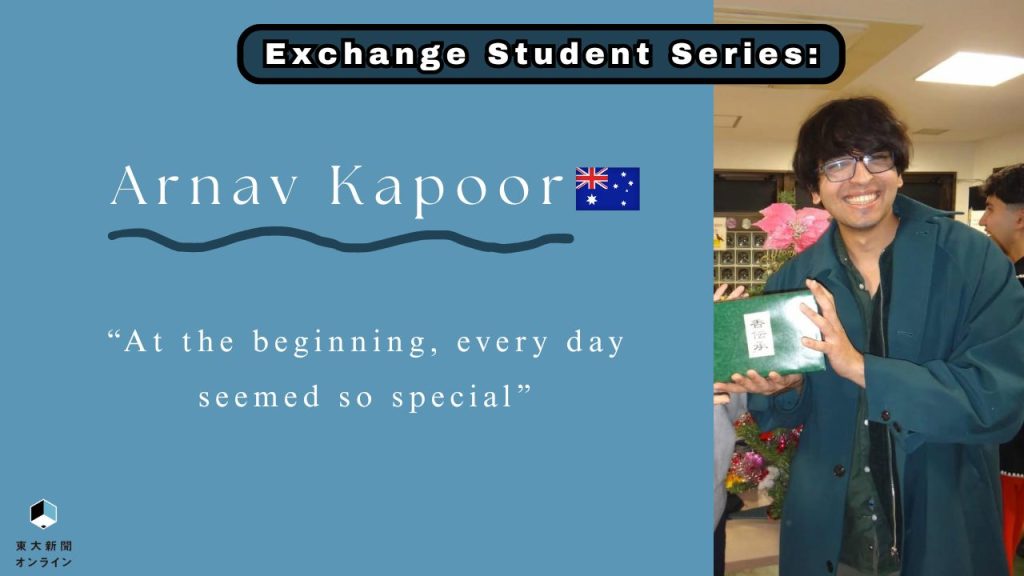
Arnav Kapoor experienced just that, studying at the University of Tokyo for a six-month exchange with the University-wide Student Exchange Program (USTEP). Born in India and having moved to Australia at the age of eight, he now studies computer science at the University of Adelaide. The Todai Shimbun sat down with Arnav to find out more about his exchange. (Interview by Kamil Zeribi)
──Why did you choose Japan?
I travelled to Japan two years back. I really liked Tokyo and it seemed very livable, in terms of studying abroad — it seemed to have everything I wanted.
──What was important for you to have in your study abroad experience?
Food is 100% the main part of traveling for me. In Tokyo, even in small buildings that you normally wouldn’t pay attention to, there’s seven floors and there’s always some hidden gem. Every single building. I thought I would never get bored.
──Are there any differences between being here as a tourist versus a six-month resident?
Adaptation was a big difference because, at the beginning, every day seemed so special. It didn’t take a long time for Tokyo to feel like home to me and while I think that can be good, the novelty faded really quickly. That’s when I also started saying to myself that maybe I should have chosen a more challenging place — somewhere less familiar. I wondered, ‘Am I killing the point of exchange?’
──Is there anything you tried to do to stop yourself from falling into a routine?
I tried to do a lot of trips, which helped break my routine a little. I went to Aomori, Beijing and to a bunch of areas near Shizuoka. That really changed things up because then I thought, ‘Okay, I’m not just in Tokyo.’ Not only that, but I travelled with people that I wasn’t super familiar with, which made the trips even more interesting.
──How has it been making friends on exchange?
Everyone has been super nice. I was really worried at the beginning because, although orientation went well, I wondered, ‘Oh, am I going to see these people again?’ I think I got really lucky because my friend group got to know each other there and we’ve stayed close since. Unexpectedly, it’s actually easier to make friends here. In Australia, it’s really hard to meet people from other courses unless you join a club.
──Have you joined any clubs during your exchange?
I joined the billiards club at the beginning. Before I arrived in Tokyo, I had wanted to join the archery club and rifle club, but it was so hard to find information about how to join. Because of UTokyo’s online interface, I just couldn’t figure it out. I eventually figured out how to join archery, but I realized the upfront cost was really high and since I’m only here for a semester, it didn’t feel practical. I couldn’t find the rifle club at all. I also did try to join badminton, but I was sick for two weeks and during that time I learned that the international students play badminton in Komaba Hall at 7 p.m., which suited me a lot more.
──How have the classes been at UTokyo?
I really like them because I get to take all the electives that I couldn’t in Australia. At UTokyo, I mostly enrolled in global liberal arts classes using my open electives. Back home, if I want to take any fun electives, I have to pay double the price for them because of how our tuition system operates. But I think the best part is the small class sizes and how interactive they are. I really enjoy going to my classes and getting to know my lecturers. In Australia, the classes are so big that even the workshops have at least 60 people. If you go to a lecture hall, it could be 200 people. In that environment, you don’t get to talk to anyone.
──How have you found making friends with Japanese students?
For me, the biggest problem was my limited language skills. I made the decision to study abroad pretty late, and then it took around four months of juggling subjects and getting faculty approval to go. As a result, I didn’t have a lot of time to study the language beforehand.
However, I did find that the local Japanese students were very interested in talking to exchange students and making friends. One of my courses had Japanese students who wanted to improve their English and meet international students.
──How do you think your experience has changed you?
I’ve been considering leaving Adelaide for a while because I want to work overseas. Living in Tokyo for six months has made it more apparent to me that I want to live overseas and experience life in different countries. In Adelaide, I feel like I’m missing out on so much. To put it simply, it’s very boring there — there isn’t much to do. It’s going to be really hard for me to go back to Adelaide after this experience.
──Do you have any advice you’d give to any future exchange students who are considering coming to UTokyo?
Definitely learn as much Japanese as you can. Although not learning Japanese won’t ruin your experience, I think it will enhance it significantly. Secondly, you should ask your home university if they can connect you with people who have already done an exchange at UTokyo. They can advise you on, for example, what courses will suit you and which courses are taught well, so you can get the experience that you want.
This interview was conducted in English and has been edited and condensed for clarity.