
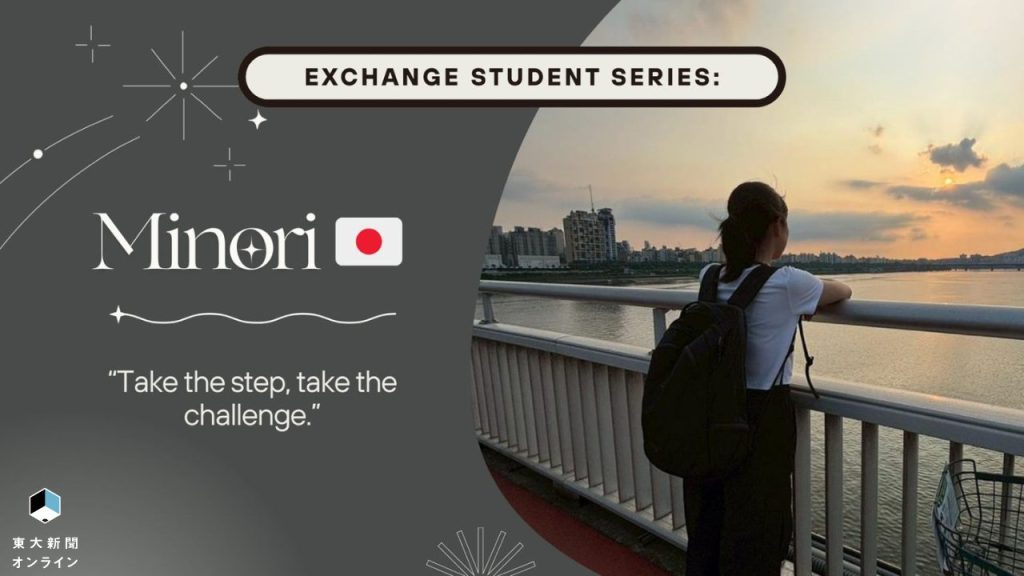
Living in a new country presents both challenges and opportunities, even for those with an international background. To learn more, the Todai Shimbun interviewed University of Tokyo student Minori, who experienced this firsthand, traveling to Seoul National University in Korea for a three-week exchange program.
Born in Japan and with experience living in the UK, Minori is a second-year student at the University of Tokyo planning to major in electrical engineering. Over the 2025 summer break, Minori participated with other UTokyo Students in an international study program (国際研修) provided by UTokyo. (Interview by Michelle Alexandra Soerjanto)
Why did you choose to study in Korea?
───Actually, going to Korea itself was a random decision, but UTokyo has a program called TLP (Trilingual Program, which has been revised and renamed to GLP-II as of 2025). It allows UTokyo students to become fluent in three languages, and pursue study abroad during their summer and spring breaks, so I wanted to take advantage of the opportunity provided.
Did you start learning Korean beforehand?
─── I’ve been taking Korean classes at UTokyo since the spring of 2024, so I had been studying Korean officially for about a year and a half.
What motivated you to study Korean?
─── I’ve been motivated to learn Korean for a long time, partly because of K-Pop and K-Drama. I started learning Hangul, the Korean alphabet, on my own when I was in junior high school, so I thought taking Korean classes at university would be the natural next step.
What is your advice for people who are learning a new language?
─── Before I came to Korea, I really thought that my language ability wouldn’t be enough since I’m not a native speaker and I had only been studying officially since entering university. But once I arrived, I realized I could manage daily life and interactions. Even if you aren’t the most confident, but are able to hold even just a three minute conversation, that’s good enough.
What was the biggest impact this experience had on you?
─── I gained confidence that I could survive in Korea. I visited France before for a family trip, but I didn’t know the language besides small phrases, so it wasn’t as rewarding of an experience.
In Korea, I felt more at home because I knew the language. I was able to interact with the locals, order in restaurants, and ask for basic things like water. Studying in a language class and actually living in the country are very different, but the experience made me realize that I could take my knowledge from class, and actually manage on my own in a different country.
Did you have opportunities to interact with Korean university students?
─── Since I went with a UTokyo program, my classmates were mostly people I already knew. Besides my classmates, we were assigned buddies from Seoul National University. We went to cafes together, spent time talking, and learned about each other’s university lives. We were able to hold a conversation, but it was a bit hard because they spoke native Korean, and I was still a beginner in comparison.
Were there any noticeable differences between Japanese and Korean universities?
─── One major difference was our campuses. Seoul National University is located at the edge of Seoul, surrounded by mountains, and is enormous. There are buses because it’s too large to walk between buildings. UTokyo, by contrast, is in the city and much more compact.
─── Another difference I noticed is Korea’s distinct café culture. Our Korean teacher at UTokyo often mentioned that almost every building has its own café, and you can easily grab a cup of coffee which I thought was really cool. Cafés there feel almost like convenience stores. They’re everywhere, even outside of campus.
What lessons did you take away from your study abroad?
─── Before studying abroad, I thought that my only option was to finish studying at UTokyo, then go to graduate school at UTokyo, and then work at a large company in Japan. Studying abroad opened my eyes to the opportunities I have outside of this. I could work in the US or a Korean company if I wanted to. I always knew these possibilities existed, but studying abroad made them feel real and achievable.
─── Interacting with so many diverse people from the US, Korea, and Japan also significantly shaped my perspective. Japan is a homogenous society, so leaving Japan was already a huge step for me. I would discuss with my professors and fellow students about Japanese-Korean relations, Korean-American relations — things I never had to think too hard about before. Studying abroad has helped me obtain a wider view of the world.
What are some difficulties and obstacles that might hold students back from doing an exchange?
─── Many Japanese students hesitate to go on exchange, feeling that potentially having to delay their graduation isn’t worth the experience. I would absolutely do a long-term exchange program if I could transfer the credits and graduate in time. As an engineering major, it’s even more complicated, as you have to take the right courses to transfer credits.
This is a little ironic because a lot of the engineering classes at UTokyo are actually delivered in English, so you’d think they would want to incentivize students to study abroad. At the same time, I sometimes question why the engineering classes are delivered in English at all. I understand that UTokyo wants to globalize, but I feel like it’s important to maintain our culture at home too.
How has your international background conflicted with your Japanese identity?
─── I’ve always had internal conflict between my international and Japanese self. For example, I went to an international kindergarten, where raising your hand was encouraged, but in Japan, it can be seen as boasting.
I feel conflicted in terms of my studies as well. On one hand, I want to study overseas for graduate school, but on the other hand, I feel a responsibility as a Japanese person to continue at UTokyo and contribute to Japan.
Do you have any advice for interested, but intimidated students who don’t have an international background?
─── I totally understand if people are hesitant to leave their home country. I would also be scared to go to a country where I don’t understand the language. But it’s important that we recognize the opportunities that going abroad offers us, specifically the chance to learn a foreign language and expand our worlds. I would definitely recommend everyone to go abroad at least once. Take the step, take the challenge.
This interview was conducted in English and has been edited and condensed for clarity.
Language, Belonging, and International Identity
Minori’s dedication to studying Korean has allowed her to feel a sense of belonging even while abroad, illustrating the importance of language towards cross-cultural connection and understanding.
At the same time, she also recognized the importance of maintaining one’s own culture and the responsibility she feels about contributing to Japan. This brings to focus the conflict between her international and Japanese self, a common experience for exchange students with complex backgrounds.
Despite any reservations she may have had before, Minori emphasized how the experience widened her perspective and opportunities, recommending study abroad wholeheartedly to others.