

Standing before academics, students, and press, Dr Leggett began his lecture by asserting that biodiversity collapse and climate change are the “defining imperatives” of our time.
On the 30th of October, the 2025 Blue Planet Prize laureates, Prof Robert B. Jackson and Dr Jeremy Leggett, gave commemorative lectures at the University of Tokyo’s Ito International Research Center. The Blue Planet Prize, named after Yuri Gagarin’s famous utterance upon the first viewing of our planet from space, “the Earth is blue”, is awarded to “individuals or organizations from around the world in recognition of outstanding achievements in scientific research and its application that have helped provide solutions to global environmental problems”. In this vein, both lectures were, at their core, solutions orientated.
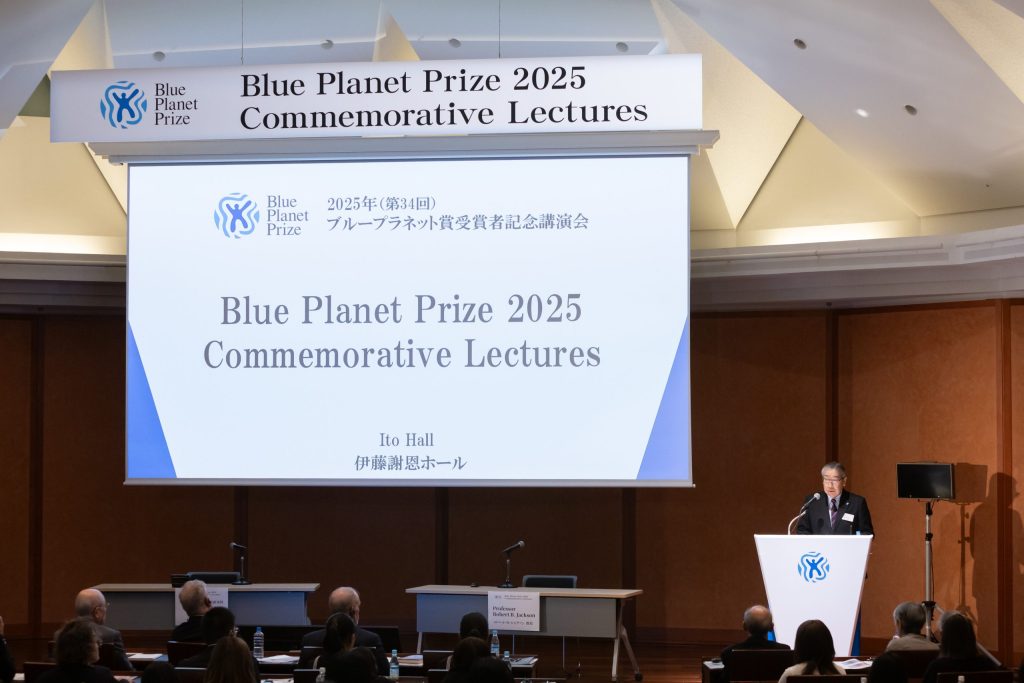
Prof. Jackson on Methane and Environmental Legislation
Prof Jackson, who teaches earth system science at Stanford University and chairs the Global Carbon Project, an institute leading efforts to monitor and reduce greenhouse gas emissions, opened the evening lectures. Prof Jackson focused his lecture, like his research, on methane. Methane is a potent greenhouse gas with a warming potential over 80 times that of carbon dioxide (CO2) over 20 years. However, while CO2 can last centuries to millennia in the atmosphere, methane has a much shorter lifespan of 10-20 years. This means that swift reductions in methane emissions would have a relatively instantaneous impact on global warming. As a result, Dr Jackson sees the drastic reduction of methane emissions as the centrepiece of climate action.

Professor Jackson stressed that achieving such a reduction requires strong government regulation, and that contrary to neoliberal perceptions, it can be a tool to incentivise private sector innovation. He provided the example of Swedish green steel company Stegra, which developed technology to create hydrogen fuel on-site at its factories to power furnaces. While coal is typically burned in the production of steel, Sweden’s 1991 carbon tax, which currently charges 1510 Swedish Krona (roughly $160) per tonne of CO2 released, forced businesses like Stegra to innovate, many becoming both more sustainable and profitable than the pre-carbon tax methods.
Prof Jackson bolstered his optimistic stance on regulation by citing the successes of past environmental legislation. The banning of leaded gasoline, pioneered by Japan in the 1970s with the rest of the world following, has reduced the level of lead in children’s blood by 96%. The Montreal protocol of 1987, which banned the production and consumption of ozone depleting substances, helped restore the ozone layer. And finally, the U.S. Clean Air Act, which was enacted in 1963, has saved 2.3 million premature deaths and produced an estimated 30x return on investment between 1990 and 2011. Dr Jackson’s examples indicate that strong political action on the climate and environment can be both lifesaving social policy and smart economic policy.
Dr Jackson left the audience with a message of urgency grounded in possibility. Cutting methane, he argued, is not a distant goal but a near-term opportunity—one that could slow global warming within our lifetimes. It is proof that smart environmental policy paired with thorough research can do more than avert disaster; it can deliver quick, measurable progress and remind us that hope in the climate fight is not naive.
Dr. Leggett’s Nature Prosperity Pump: Linking Ecology, Economy, and Society
Dr Leggett, a former petroleum geologist, now climate activist and entrepreneur took to the stage next, warmly received by many of his previous Japanese colleagues. The transformations in Leggett’s career traces the evolution of the modern environmental movement. In the 1980s he worked as an oil exploration geologist—part of an industry soon to face scrutiny as the climate crisis entered public debate. His geological research led him to deep concern about planetary instability, prompting a shift from extraction to activism as climate science and policy gained global traction in the 1990s. He then participated in the 1997 Kyoto Protocol negotiations before turning to enterprise, founding Solarcentury to help solar energy go mainstream across Europe and Africa during the start of the renewable boom in the 2000s. Now, at Highlands Rewilding in the Scottish Highlands, he operates at the frontier of natural capital markets, linking ecological restoration to economic renewal.

Dr. Leggett argued that effective environmental policy must deliver tangible economic benefits if it is to endure politically. He outlined his proposal of the “Nature Prosperity Pump”, which embodies this argument. Merging technology and shared social responsibility, the Nature Prosperity Pump combines three main elements: large-scale forest restoration, sustainable timber production, and affordable housing built to low-energy Passivhaus standards, which reliably minimise energy use. The concept is simple: forests absorb CO2 and support biodiversity. Using timber for construction stores that carbon in buildings long term while reducing emissions from cement and steel. This creates mass-produced, energy-efficient homes that lower living costs. Each cubic metre of wood, Dr Leggett notes, locks away roughly a tonne of CO2. If done at the scale of “two billion timber buildings”, Dr Leggett suggests this would be enough to return to pre-industrial atmospheric carbon levels. While the example is extreme, he uses it to illustrate the theory’s potential and to show what could be achieved on a smaller scale alongside other climate policies. His Nature Prosperity Pump theory is also political, demonstrating how environmental degradation, inequality and democratic decline are interlinked. Rising inequality, he observed, has fuelled anger and polarisation. That anger weakens democratic institutions, and when democracies falter, so too does environmental leadership. “Failure to protect democracy,” he warned, “is increasingly failure to protect the planet”. Projects that couple ecological repair with visible improvements in living standards, he suggests, can help reverse that trend. By generating rural employment, affordable housing and community ownership, the Nature Prosperity Pump would, in his view, reduce the grievances that populist movements exploit.
Dr Leggett sees Scotland as “an ideal nation” for the Nature Prosperity Pump. He argues that the country’s overlapping crises of housing, biodiversity loss, and rural inequality create the conditions for a project that unites environmental recovery with economic renewal. Six key groups, he says, are already positioned to participate: the Scottish Government, the emerging nature-recovery industry, the forestry and construction sectors, local communities, and companies seeking biodiversity credits. Government policies already point in the right direction, with biodiversity restoration targets for 2045 and plans to introduce a Passivhaus-equivalent building code. The forestry sector is increasingly aware of the need for more biodiverse, sustainable management, while timber-based construction is economically pragmatic, creating affordable, low energy housing and new rural employment. A national Nature Prosperity Pump, he concludes, would align these interests: helping Scotland meet climate and biodiversity goals, revitalising rural economies, and addressing housing shortages. All that’s missing, he suggests, is the “spark to ignite the fuse” – coordinated investment.
To solve this, Dr Leggett recommends that the Nature Prosperity Pump could begin with a fund, created by those most exposed to environmental risk. He proposes a consortium of four such groups: insurance conglomerates threatened by rising uninsurable losses, timber-reliant retailers dependent on sustainable forests, multinational corporations with vulnerable global supply chains, and state pension funds reliant on a stable future economy. Together, their self-interest and resources could catalyse large-scale investment in nature recovery and sustainable construction.
While ambitious in scope, the Nature Prosperity Pump remains more a conceptual framework than an actionable policy blueprint. This is because its global applicability is uncertain: the model is rooted in rural land use and timber-based housing, whereas the majority of the world’s population is urban. However, its strength lies in bringing together environmental recovery, economic renewal, and democratic stability within a single narrative. As a result, if successfully implemented in Scotland, the model’s underlying logic, rather than its specific form, might inform wider strategies for linking ecological repair to social wellbeing.
Practical Steps and Hopeful Solutions
The 2025 Blue Planet Prize lectures ultimately offered two complementary visions of climate action: one grounded in immediate, measurable mitigation and the other in long-term systemic renewal. Prof Jackson’s address highlighted the practical urgency of cutting methane emissions — an intervention capable of slowing global warming within decades—while demonstrating that strong regulation can drive innovation and deliver social as well as environmental dividends. Dr Leggett, in contrast, cast his gaze further ahead, framing the Nature Prosperity Pump as a conceptual model for linking nature recovery, economic fairness, and democratic resilience. Both speakers rejected climate doomerism, arguing that effective climate policy must align moral purpose with material benefit. Taken together, their messages fused scientific precision with political realism: that progress depends not only on technological capacity but on institutions and citizens willing to act with shared intent.