
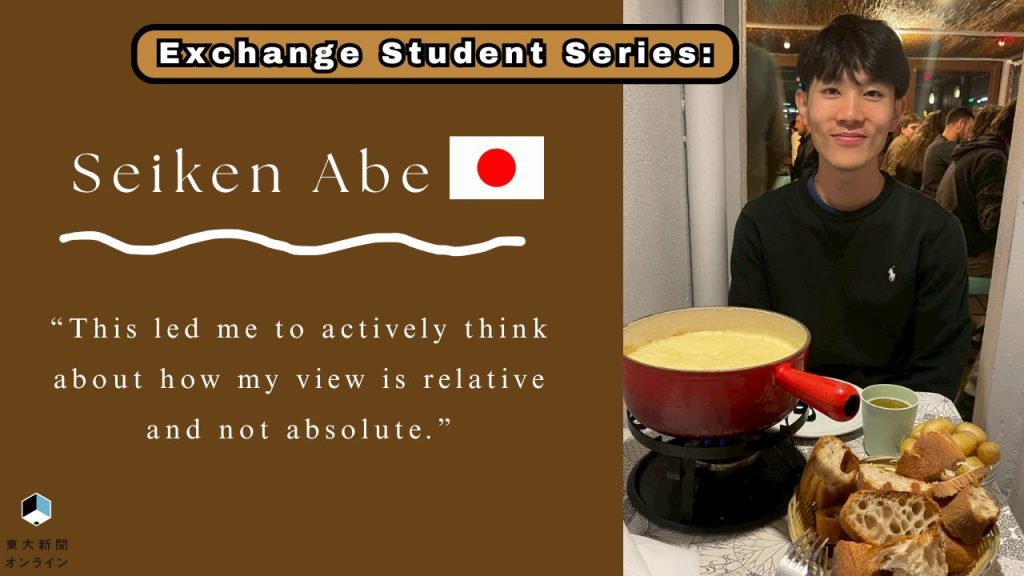
Participating in an exchange can be a career-enriching opportunity, greatly shaped by the host city’s characteristics. To explore this particular aspect of academic exchanges, the Todai Shimbun interviewed Seiken Abe, a fourth-year University of Tokyo student studying International Relations. He is currently studying at the University of Geneva and will be there for a full academic year, as of autumn 2025.
Born in Japan and having lived in France for several years during his childhood, Abe was inspired to choose the University of Geneva for an exchange by his aspirations to work for international organisations and by an encounter with a Swiss exchange student at UTokyo.(Interview by Camille Lemenager)
───When did you start learning French?
I studied French at UTokyo for over 3 years. I was in a programme called TLP (rebranded to GLP-II as of 2025, the programme allows students to learn a third language intensively). I belonged to the programme for one and a half years, and even after that I continued to study French.
───Why did you choose to study abroad in Geneva?
I actually found out about the University of Geneva through a Swiss exchange student studying at UTokyo, which led me to look into it further.
From there, I think the biggest reason that I chose Geneva is that many international organisations have their headquarters there. Since my second year of university, I wanted to work for an international organisation, so I thought, with my experience in France and French, that it would be ideal to study in Geneva. Actually, as it turns out, I might be able to get an internship here next term.
───What is your favourite and least favourite part of living in Geneva?
I generally like Geneva. Particularly the cleanliness, the safety, that people are decently nice, and that the trains are punctual. But what I don’t really appreciate about Geneva is the prices, because the cost of living is really expensive – even compared to France or Germany. Also, maybe this is just my personal preference, but in Geneva, there are not many people. When I walk around the city or go to the popular areas, compared to Tokyo or Paris, it doesn’t feel lively at all to me.
───What has been the best way for you to meet people?
There are many events that exchange students can attend. For example, there was something called ‘Global Village’, where many students from different countries or regions bring food and get to know each other. There are also many different types of short trips, which are not directly organised by the university, but put together by student organisations.
───What professional opportunities are available at the University of Geneva?
Last semester, a professor invited a lot of high-level individuals who work in the government or with international organisations to speak about international negotiation. Every single class was invited by the professor to attend. I think this really exemplifies, as I said earlier about Geneva, how the quantity and proximity of international organisation headquarters is incredibly beneficial and provides a lot of opportunities for students. Guests can easily come to the University of Geneva to give lectures and answer student questions.
───What are your favourite aspects of student life in Switzerland?
The main thing that I like about the University of Geneva is that it is so international. For example, the faculty, other students and the town itself have a super diverse population. Not only that, but there are also many international opportunities, such as the previously mentioned lectures given by those working at international organisations.
───What is your biggest takeaway from studying abroad?
My biggest takeaway so far from studying at the University of Geneva, although it’s not specifically as a result of being in Geneva, is that people see the world differently. Through my classes and conversations with other students, I realise that I see things like history or current events from the perspective of a Japanese person – in a different way from other people, from other countries. This led me to actively think about how my view is relative and not absolute.
───Do you have any advice for UTokyo students that are considering going on an exchange?
If you’re wondering whether or not you should go, I would definitely recommend it to anyone since it’s only one year. Even if you have to be a year behind, it’s still worth it. There are many people of different ages in university, so you won’t even care or notice.
───Do you have any final thoughts for the reader?
Recently, the yen has been steadily weakening, with a much sharper decline since the summer. If anyone is considering studying abroad, I would recommend for them to go as early as possible, because I do not think that the trend will change- if you wait, the cost of living will only become more expensive.
This interview was conducted in English and has been edited and condensed for clarity.