
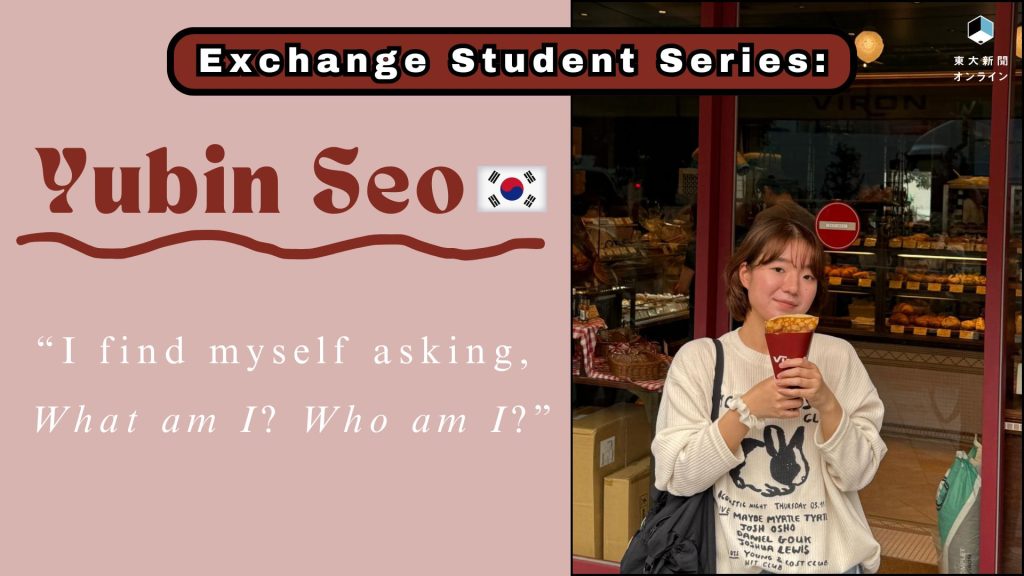
From becoming an ‘alien’ in a new culture to discussing gender issues in Japan, these were all aspects of exchange student life at the University of Tokyo for Yubin Seo. The Todai Shimbun sat down with Yubin as part of our new Exchange Student Series, where we will interview international and UTokyo students who have done exchanges at each other’s countries.
Yubin was born and raised in Busan and is a fourth-year student at Korea University in Seoul, where she majors in Korean Language Education. She is currently studying in the University-wide Student Exchange Program (USTEP), designed for UTokyo partner-university students, taking classes at Komaba Campus from October 2025 to January 2026. (Interview by Chad Nickson)
──Why did you decide to come to Japan?
Since I was young, I have had a dream to live abroad. As a result, I think it was important to me to go on an exchange during university and, besides English, Japanese is the only foreign language I speak. I am also interested in Japanese anime and dramas.
──How long have you been studying Japanese?
Although I started in high school, my Japanese is still not good…
──What made you interested in studying Japanese?
When I began learning Japanese, it was like an alien language and intriguing to me, so I wanted to improve. Then I started watching Japanese dramas, and I became even more interested in Japan.
──Had you been to Japan before going on exchange?
Yes, to visit twice, but just to Tokyo.
──Are there any differences between being a tourist and a resident?
Oh yes, it is very different. Although it’s difficult to explain, when travelling I am just a tourist, but now as a resident of Meguro-ku, with a My Number card and Japanese National Health Insurance, I think it’s more complicated. I find myself asking ‘What am I? Who am I?’
──What are some of the difficult parts of living in Japan?
Japan’s public transport is so expensive compared to Korea. In Korea, you can transfer for free within 30 minutes, but in Japan, you can’t. My Korean friends were shocked and said, “Oh my god! Transfers aren’t free?” However, daily affordability is generally the same.
──What do you like about living in Japan?
That’s difficult, I can’t choose only one thing… I lived in Korea for 25 years, my whole life, and I am only Korean. This is the first time that I am a foreigner, like an alien. Since this isn’t a common experience, I think it is very cool. Like I said before, I often ask myself now ‘Who am I?’, which I think is a common experience on exchange.
──Have you experienced anything that you would describe as a culture shock?
I think Japanese people are very polite. Also, I heard that some Japanese people find it strange when a woman eats alone in a restaurant, which was quite a shock to me. While I haven’t experienced that myself, I have heard stories from my friends that Japanese people see cafés as cute and more like women’s spaces compared to restaurants. In Korea, it is similar in that women often go to these cafés, but generally society doesn’t perceive them as only for women.
──Did you have any pre-conceived ideas about what life in Japan was going to be like?
I didn’t have special expectations for Japan, but I was nervous before coming. I thought ‘Oh, it’s a foreign country, I will be a foreigner, my family and friends will be far, and I will be alone.’ Now that I’m actually here, I keep seeing Korean restaurants often and think, ‘Oh my god, why do I miss Korean food so much?’
──What’s your favourite Korean restaurant that you’ve been to?
My favourite Korean restaurant is difficult, but near Komaba Campus there is Park Shikdang. The lunch menu is delicious and cheap.
──What are your favourite things to do in Tokyo?
I like to walk along the streets and see the people; Japan’s streets are very clean and peaceful.
Shibuya is also cool, but has so many people, shopping malls and tourist spots… I would recommend Shimokitazawa, near Komaba campus, instead. There are less people than in Shibuya, but there are still a lot of shopping malls, restaurants, and cafés.
──How has it been making friends?
I was very nervous to make international friends because I don’t think that I speak English well, but I’ve been able to. Also, I’m surprised that people want to exchange Instagrams after meeting for the first time. In Korea, we don’t usually do that.
For local students, I don’t interact with them often, but in class I’ll say hi or konnichiwa.
──What is something you have really enjoyed about your life at Todai?
I think what I enjoy the most is that I can communicate with other international students. Since my major is Korean Language Education and my second major is History Education, all the students in my classes at home are Korean and I don’t really get to interact with international students.
──Are there any large differences between studying at UTokyo and Korea University?
I think Todai has more diverse courses. My courses include Writing Games: Experimental Writing as Social Practice, Women in Science, Peace and Coexistence, and a course about languages and AI. Writing Games has lots of unusual writing skills and is very fun, while Peace and Coexistence is taught in Korean and focuses specifically on the literature of the Korean poet Yi Yuksa. In Women in Science, I can discuss lots of gender and sex issues with others. In Korea, people can be more sensitive, but here in Japan, I feel like I can speak more freely about these issues.
──What advice would you give to a student who is considering studying abroad or who is already studying abroad in Japan?
Just enjoy your experience of living in Japan! I said this already, but I was very nervous before living in Japan because it was my first exchange. I thought I would struggle, but now I’m very happy. I think it’s very cool, just living in Japan as a foreigner, like a third person or alien. Don’t feel nervous, just enjoy the experience.
──Are there any final thoughts you want to leave the readers with?
I think these experiences can broaden your horizons. Before I decided to do the exchange programme, a lot of previous exchange students said, ‘It’s a good experience, you must go on exchange.’ I didn’t fully understand why at first, but now I agree. I strongly recommend doing an exchange, any country is okay!
This interview was conducted in English and has been edited and condensed for clarity.
Navigating Identity and Gender Perspectives as an International Student
Yubin’s remarks highlight the identity issues that many international students at UTokyo can face, stuck halfway between being visitors and members of Japanese society. Despite this, experiencing this with fellow international students helped her to overcome these challenges.
Finally, Yubin shared impressions she has heard about how women eating alone can sometimes be viewed in Japan, such as cafés being seen as more “feminine” spaces compared to restaurants. Though she hasn’t experienced this herself, she said UTokyo feels like a comfortable place to discuss these kinds of cultural perceptions.
The following article in the Exchange Student Series will interview a UTokyo Student who studied abroad in Korea.